Most people look through a kaleidoscope and assume the patterns are somehow random. They are not. Every six-pointed star, every bold cross, every intricate mandala is the direct result of a specific mathematical relationship between the mirrors inside. Change the angle by a few degrees and you get a completely different pattern.
Understanding how this works is part of what separates a collector who appreciates a kaleidoscope from one who truly understands it.
The basic principle
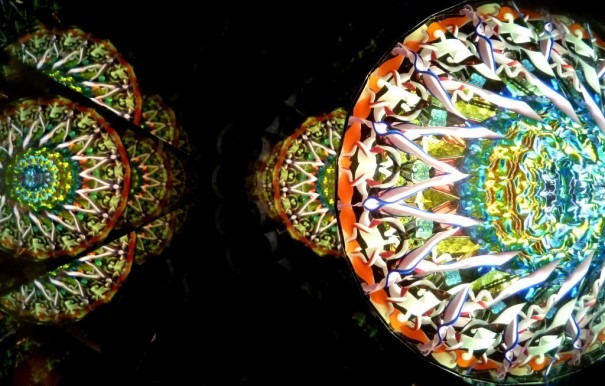
When light enters a kaleidoscope it bounces between the angled mirrors, creating multiple reflections that stack into a symmetrical pattern. The angle between those mirrors controls how many times the image reflects, which directly determines the structure of what you see.
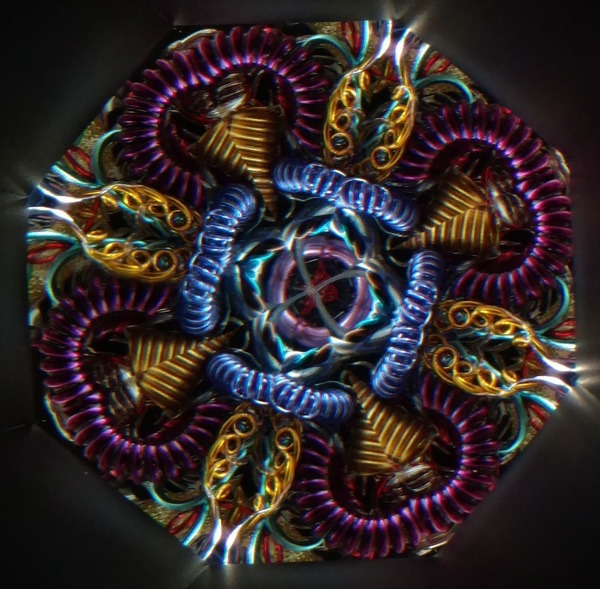
The formula is straightforward: divide 360 by the mirror angle, then subtract one, and you have your reflection count. A 60 degree angle gives you 5 reflections plus the original image, producing the classic six-element pattern. A 90 degree angle gives you 3 reflections, which produces four-element patterns: squares, crosses, or diamonds depending on what is in the object chamber.
What makes this particularly satisfying is that angles which divide evenly into 360 produce complete, balanced patterns with no fractional elements around the edges. Angles that do not divide evenly produce patterns where something is slightly cut off at the boundary, which some artists use deliberately for effect, but which tends to feel slightly unresolved to most viewers.
What Brewster recommended and why
David Brewster, who patented the kaleidoscope in 1817, spent considerable time working out which angles produced the most pleasing results. His patent specified 18, 20, and 22.5 degrees as particularly effective. These narrow angles generate high reflection counts. 18 degrees produces 19 reflections, which fills the viewing field with intricate, densely layered detail.
In his later treatise he recommended wider angles: 30, 36, and 45 degrees. These produce fewer reflections but each element is more distinct and easier to read. Fewer reflections also means less light loss between mirrors, which results in brighter, more vibrant images. There is a real trade-off between complexity and clarity, and Brewster’s two sets of recommendations reflect two different aesthetic priorities.
The angles most commonly used and what they produce
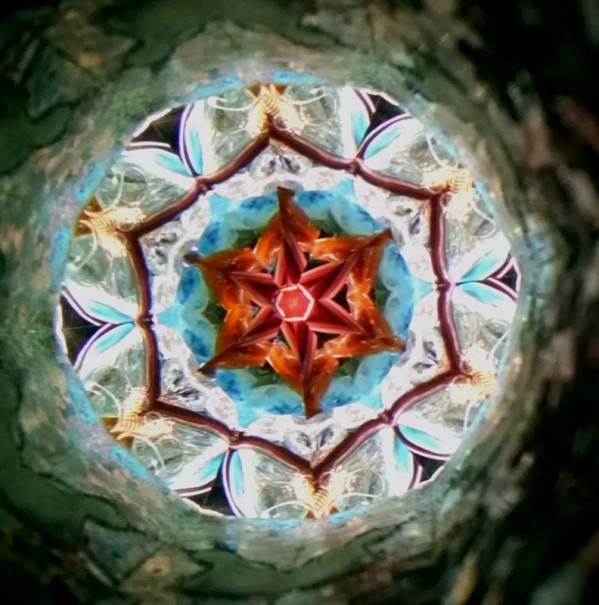
The 60 degree angle is probably the most familiar configuration. It produces the classic six-pointed star and hexagonal pattern that most people picture when they think of a kaleidoscope. The hexagonal shape turns up throughout nature (in snowflakes, in honeycomb cells) which may be part of why it feels so immediately satisfying to look at.
At 90 degrees the pattern shifts to four-fold symmetry: squares, crosses, and diamond arrangements. The right-angle configuration is also the most forgiving to build, since perpendicular mirrors are easier to align precisely and maximize light efficiency through the system.
The 45 degree angle produces eight-point patterns, and 36 degrees produces ten-point designs. Both sit in a useful middle ground, with enough elements for visual richness without becoming overwhelming. These tend to work well for kaleidoscopes intended for extended or meditative viewing.
At the narrow end, 18 and 22.5 degree angles produce the kind of dense, intricate patterning that rewards close examination. The trade-off is that they require exceptionally precise mirror alignment. With that many reflections, even a small alignment error compounds through the system and shows up as blur or distortion in the final image.
Beyond two mirrors
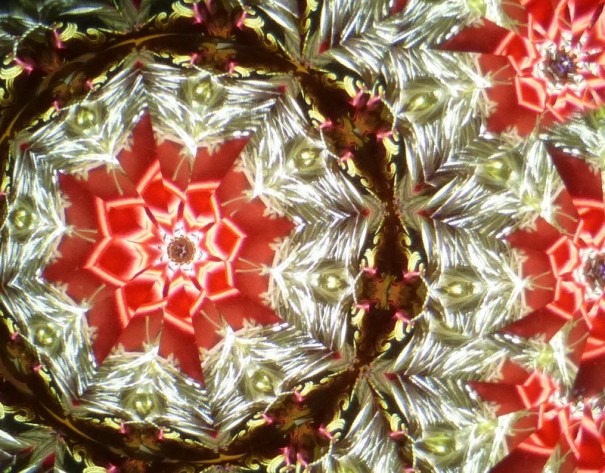
Brewster himself experimented with what he called the Polycentral Kaleidoscope, which used three mirrors arranged at 60 degree angles to each other. The triangular configuration produces an infinite repeating field that fills the entire viewing area without the dark border areas you get with a two-mirror system. He described the effect as “uncommonly splendid,” which for a Victorian scientist is about as effusive as it gets.
Steve Gray’s Parasol mirror system is a contemporary example of this kind of thinking taken further. Rather than working within the standard two-mirror framework, Gray approached pattern creation from a fundamentally different angle, literally. The Parasol system produces cascading mandala effects with a sense of depth that conventional configurations cannot achieve, and it demonstrates what becomes possible when you understand the underlying mathematics well enough to work outside the usual constraints.
Mirror quality matters as much as mirror angle
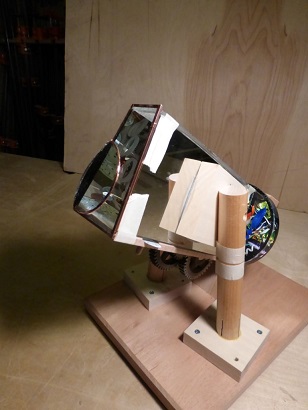
All of this mathematical precision is only as good as the mirrors used to execute it. Poor quality mirrors introduce distortion at each reflection, and with a high-reflection-count system that distortion multiplies. First-surface mirrors, where the reflective coating is on the front of the glass rather than behind it, make a significant difference in image clarity, which is why serious kaleidoscope makers use them rather than standard household mirror glass.
Precise placement is equally important. Professional makers use jigs and measurement tools to hold mirrors at the exact intended angle during assembly. A fraction of a degree off in a 20-reflection system will produce visibly misaligned patterns that no amount of adjustment to the object chamber will fix.
Why this matters to collectors
Knowing the math behind mirror angles gives you a more informed way to evaluate a kaleidoscope. When you look through a well-made instrument and the pattern is clean, balanced, and fully symmetrical right to the edges, you are seeing the result of choices made carefully at every stage: the angle, the mirror quality, the precision of the assembly. When any of those elements is off, the pattern tells you.
Take a look at the gallery to see how these principles show up in Steve Gray’s work across different configurations.