Ever noticed that some kaleidoscopes produce slow, flowing patterns that seem to drift on their own, while others create sharp, sudden shifts with a satisfying clink? That difference comes down to one thing: what is inside the object cell at the end of the tube.
It sounds like a minor technical detail, but it completely changes the experience of using the instrument. Understanding the difference helps a lot when you are deciding which kind of kaleidoscope to add to a collection, or simply figuring out which style of viewing you prefer.
How liquid changes the experience
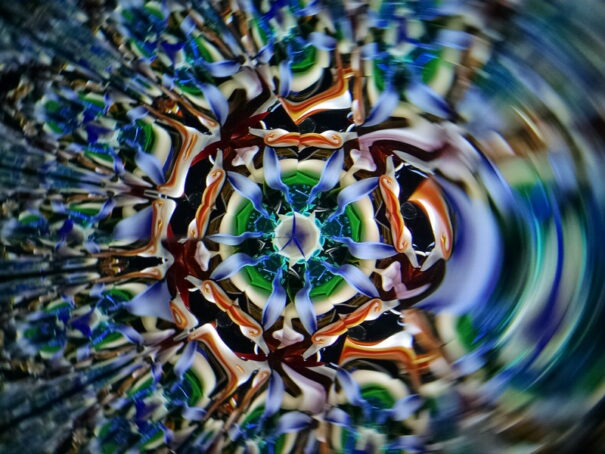
In an oil-filled kaleidoscope, the object cell contains a viscous liquid — typically mineral oil, glycerin, or silicone — along with glass beads, crystals, and other decorative elements. The liquid slows everything down. Objects drift and float rather than tumble, which produces patterns that evolve gradually and respond to even the smallest movement.
The sensitivity is one of the more remarkable things about liquid-filled systems. Natural hand tremor, breathing, even resting the scope lightly on a surface is enough to keep objects in gentle, continuous motion. You do not need to actively rotate or shake the instrument. The patterns just keep developing on their own.
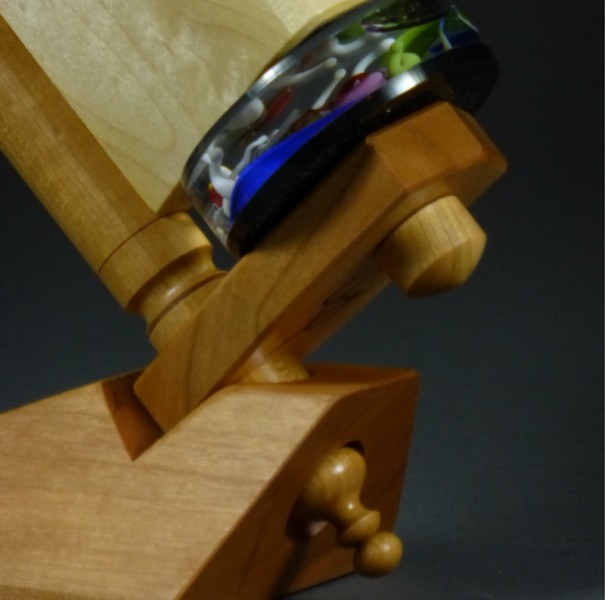
Steve Gray’s oil-filled pieces demonstrate this particularly well. Glass beads and natural stones drift through the medium with a kind of unhurried grace that is hard to describe accurately in words — it is one of those things that makes more sense once you have actually looked through one.
What dry cells do differently
Without liquid to slow things down, objects in a dry cell move quickly. Tilt the scope and everything tumbles to a new position in an instant, creating a sharp transition between one static composition and the next. That click or clink you hear as the pieces resettle is part of the experience — it is immediate, tactile feedback that adds a multisensory dimension to the viewing.
The stillness between movements is part of the appeal for a lot of collectors. Once the objects settle, the pattern holds perfectly until you decide to change it. That stability makes dry kaleidoscopes particularly good for studying color relationships and geometric detail, and they work well for photography since you can hold a composition as long as you need to.
There is also a degree of control with dry cells that liquid systems cannot quite match. You decide when to create a new pattern and when to sit with the existing one. The experience is more deliberate, which suits certain viewing preferences better than the continuous, organic motion of an oil-filled scope.
A few practical differences worth knowing
Oil-filled kaleidoscopes are noticeably heavier than dry ones. The liquid adds weight, which affects both how the instrument feels in the hand and what is involved in shipping and handling. Good liquid-filled scopes also require quality sealing to prevent leaks, which adds to the manufacturing complexity and typically the price.
The liquid itself needs to be highly transparent. Any cloudiness or impurity creates optical distortion that reduces pattern clarity and can alter how colors appear. Quality mineral oil resists yellowing and holds its clarity over time. Lower-grade liquids can develop haze, which is one of the reasons there is a noticeable price difference between well-made and cheaply made liquid-filled scopes.
One question that comes up occasionally is why the entire tube is not filled with liquid rather than just the object cell. The answer is optical — the mirror system is designed to focus on objects at a specific point at the end of the tube. Filling the whole tube would create focus issues that blur and distort the reflected image. The concentrated cell design is what allows liquid systems to achieve their flowing motion while maintaining the sharp, clear patterns that make a kaleidoscope worth looking through in the first place.
Which one suits you better
If what you want is something meditative — a viewing experience that is continuously changing and does not require much active participation — an oil-filled kaleidoscope is likely the better fit. The patterns develop on their own, the motion is gentle and unhurried, and the overall experience tends toward the relaxing end of the spectrum.
If you prefer more control, or you want to be able to study a specific arrangement without it shifting on you, a dry cell scope gives you that. The experience is more interactive in a deliberate sense — you are making choices about when to change the pattern rather than watching it evolve independently.
Both types can incorporate rotating cells that turn independently of the main body, which allows for pattern changes without tilting the whole instrument. This is particularly useful for stand-mounted parlor scopes, and the motion characteristics of each system carry through to how the rotating cell behaves — fluid and continuous in a liquid scope, crisp and clicking in a dry one.
Neither is objectively better. They are genuinely different experiences, and a lot of serious collectors end up with examples of both. Take a look at the gallery to see how Steve approaches each style.