Most people remember the kaleidoscope as a childhood novelty, as something you’d pick up at a gift shop, spin a few times, and forget about. But the history behind it is a lot more interesting than that, and the question of what it’s made from turns out to matter more than you’d expect.
The story runs from ancient Egyptian mirror-makers all the way through Victorian parlor culture, mid-century mass production, and into the hands of contemporary woodworkers like Steve Gray, who are making the case that the kaleidoscope belongs in an art collection rather than a toy box.
It starts with mirrors
The conceptual roots of the kaleidoscope go back further than most people realize. Ancient Egyptian artisans were polishing copper and bronze mirrors thousands of years ago. It wasn’t just for vanity, but for ceremonial purposes and architectural lighting. More importantly, they were demonstrating something that would take centuries to formalize: that light can be redirected, multiplied, and controlled through the right materials.
Greek scholars later put mathematics behind it. Euclid worked out the geometry of reflection. Ptolemy explored how angles and symmetry shape what we see. None of them built anything resembling a kaleidoscope, but they laid the groundwork for the optical principles that make one work. And from the very beginning, material choice mattered. Polished metals provided the clarity and durability that made precise reflection possible.
Brewster’s invention: a scientific tool, not a toy
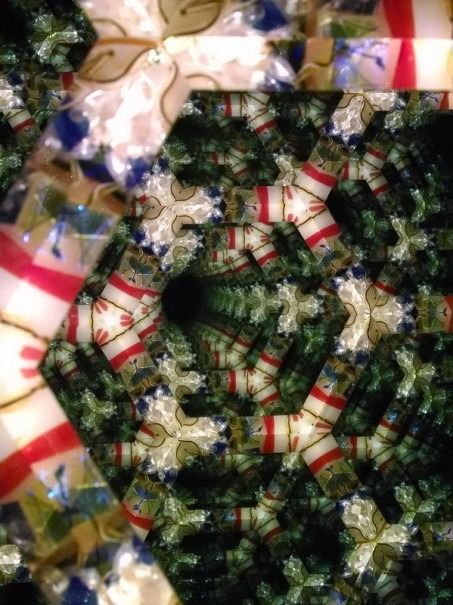
The kaleidoscope as a defined device appeared in 1816, when Scottish physicist Sir David Brewster patented it. Brewster wasn’t trying to make something fun. He was a serious scientist studying light polarization, and he designed the kaleidoscope as an analytical instrument. His insight was that mirrors arranged at precise angles could generate symmetrical patterns from small fragments in an object chamber, and that even a modest arrangement could produce what he calculated to be an almost limitless number of combinations.
His vision for it was practical: a design aid for artists and craftspeople working in textiles, architecture, stained glass, and decorative arts. Early versions used brass fittings, not for aesthetic reasons, but because brass was the material of serious scientific instruments at the time. Durable, machinable, and precise. It signaled that this was something to be taken seriously.
The Victorian era: brass, parlors, and polish
Through the nineteenth century, kaleidoscopes became genuinely fashionable, particularly in Victorian Britain and North America. They sat in parlors alongside stereoscopes and microscopes – objects that signaled intellectual curiosity and cultural refinement. Brass was everywhere in these designs. Its resistance to corrosion, its weight, and its polished finish fit perfectly with the era’s taste for mechanical elegance.
Makers like Charles G. Bush in the United States started pushing the form further, introducing liquid-filled object chambers that created continuously shifting patterns. These more sophisticated designs often combined brass hardware with wooden stands and accents, and that combination is worth noting. Even then, the two materials were doing different jobs. Brass provided structural integrity and mechanical precision. Wood offered warmth, stability, and visual balance. The pairing worked because each material was doing what it does best.
The decline: when plastic took over
By the mid-twentieth century, kaleidoscopes had largely been reduced to cheap novelties. Plastic replaced brass. Wood disappeared entirely. The focus shifted to producing something that could be sold inexpensively and at scale, and the craftsmanship that had made Victorian examples genuinely interesting got lost in the process.
The result was predictable: the kaleidoscope became associated with disposability. Something for children, not collectors. Something you’d find in a gift shop, not a gallery. It took a few decades and a significant cultural shift to change that.
The revival: and why wood came to the front
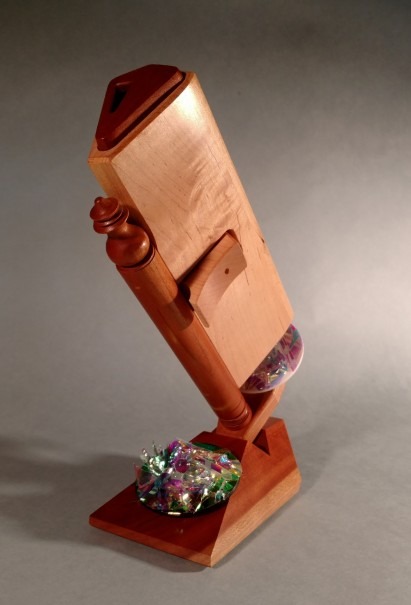
The turnaround started in the 1970s, driven by a broader renewed interest in handmade objects and artisan craftsmanship. Artists and collectors started looking at the kaleidoscope again and recognizing that its expressive potential had been almost completely squandered by mass production. Material choice came back into focus.
Brass had a role in this revival. Its connection to Victorian craftsmanship and scientific instruments gave it a certain historical authority. But contemporary artists increasingly moved toward wood as the primary material, not just as an accent but as a defining structural and aesthetic element. And it’s not hard to understand why.
What wood does that brass can’t
Brass is consistent. Every piece behaves the same way, looks largely the same, and ages in the same direction. That consistency is part of its appeal for precision components, but it also means that one brass kaleidoscope looks a lot like another.
Wood is the opposite. Every piece of hardwood carries its own grain pattern, color variation, and texture. No two are identical, which means every wooden kaleidoscope has a character that’s entirely its own before the artist has even started shaping it. Properly finished hardwood also handles use gracefully. It doesn’t dent the way thin metal does, and minor surface wear tends to add character rather than detract from it.
There’s also the tactile dimension. Brass conducts temperature, which means it tends to feel cold in the hand. Wood stays closer to body temperature, which makes a significant difference in how you experience holding and rotating something over time. For an object that’s meant to be handled and revisited, that matters.
And then there’s the visual contrast that wood creates with the interior optics. The organic warmth of a hardwood exterior against the precise geometric symmetry you see when you look through the scope. That tension between the natural and the mathematical is part of what makes a well-made wooden kaleidoscope compelling as an object.
Steve Gray’s approach
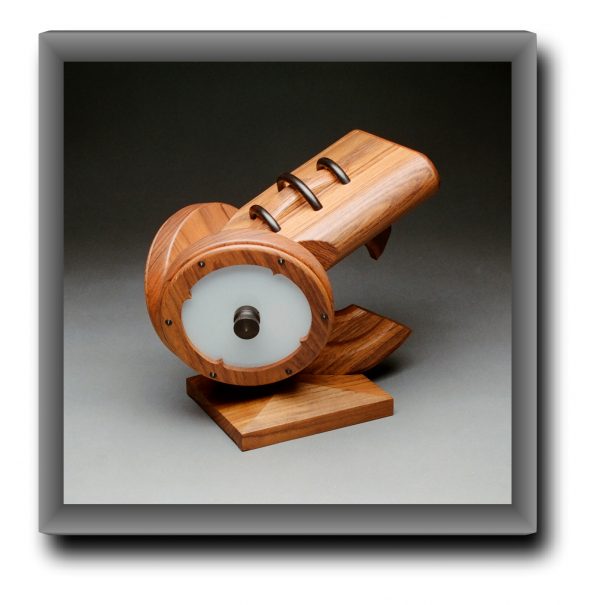
This is the tradition Steve Gray works in. His background is in woodworking, and he treats the wood not as a housing for the optics but as a central design element in its own right. The selection, shaping, and finishing of the wooden body is as deliberate as the optical alignment inside. The two aren’t separate concerns but parts of a unified object.
What that produces is a kaleidoscope where the exterior and the viewing experience reinforce each other. The weight and balance of the wood influence how you hold it. The texture of the surface influences how you rotate it. The overall feel of the piece shapes how often you come back to it. These aren’t incidental qualities. They’re the result of treating material choice as seriously as optical design.
A living tradition
It’s worth mentioning that the kaleidoscope community is more active than most people realize. The Brewster Kaleidoscope Society connects artists and collectors across generations, with annual conventions, exhibitions, and publications that keep the history of the form alive and developing. This isn’t a niche of hobbyists preserving a dead craft. It’s a community of serious artists and collectors who are actively expanding what the kaleidoscope can be.
The arc from ancient Egyptian copper mirrors to Brewster’s optical instrument to Victorian brass parlor pieces to mid-century plastic novelties to contemporary handcrafted wooden art objects is a longer and more interesting story than the kaleidoscope usually gets credit for. The current emphasis on wood and craftsmanship isn’t nostalgia. Tt’s a return to taking the form seriously.
Take a look at the Etsy store to see what that looks like in Steve’s hands.